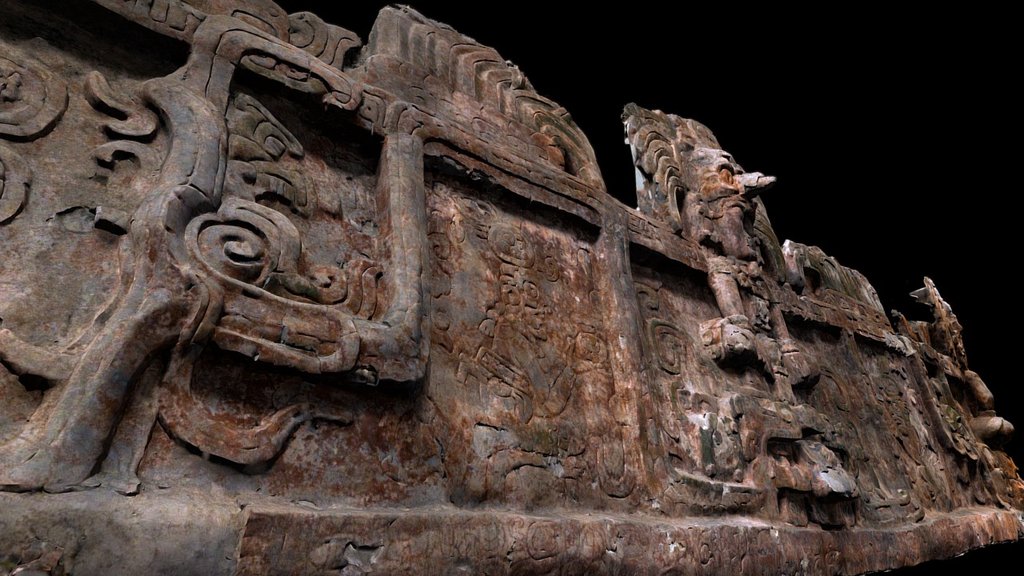
Holmul Frieze 3d Model
Holmul Frieze 3d Model – Unveiling Ancient Maya Cosmology
This extraordinary frieze masterfully articulates a profound religious scene, central to Maya spiritual beliefs and royal authority. Carved with remarkable precision, the narrative likely chronicles mythological events or the divine lineage of the Holmul monarch, serving as a powerful visual declaration of his sacred right to rule. Scholars continue to interpret the rich symbolism embedded within its figures and glyphs, which provide invaluable insights into the complex worldview of this ancient civilization.
The frieze’s iconography, featuring deities, ceremonial objects, and possibly ancestral figures, speaks volumes about the Holmul people’s understanding of the cosmos. Each element contributes to a larger story, illustrating the interconnectedness of human rulers, divine powers, and the cyclical nature of existence. Studying this digital rendition allows for closer examination of these intricate details, fostering new interpretations and deeper appreciation for Maya artistic and intellectual achievements.
Holmul Frieze 3d Model – The Holmul King and Snake Dynasty Ties
At the heart of the frieze stands the Holmul king, a pivotal figure whose burial the artwork commemorates. His depiction likely portrays him in a deified or semi-divine state, emphasizing his role as an intermediary between the human realm and the gods. The context of his tomb underscores the profound significance of this artwork, designed to accompany him into the afterlife and perpetually reinforce his legacy.
Crucially, the inscription on the frieze hints at a powerful alliance with the Kaanul, or “Snake” dynasty, a dominant force in the Maya lowlands. This connection reveals the strategic political maneuvering and extensive networks that characterized the Classic Maya period. The frieze thus functions not only as a religious artifact but also as a historical document, offering tangible evidence of regional power dynamics and diplomatic ties that shaped ancient Mesoamerica.
Precision Digital Preservation
Scientists faced considerable challenges when documenting the physical frieze, navigating the tight confines of an excavated tunnel. Employing advanced 3-D scanning technology, they meticulously captured precise measurements and textures, ensuring that every nuance of the original carving translated into this digital archive. This process demonstrates the incredible synergy between archaeological discovery and cutting-edge digital preservation techniques.
The resulting holmul frieze 3d model represents a triumph of modern scientific methodology applied to ancient heritage. It democratizes access to this otherwise fragile and inaccessible artifact, making it available for study, education, and appreciation worldwide. This digital rendition ensures the frieze’s details remain perfectly preserved for future generations, irrespective of the physical original’s condition.
- High-resolution mesh: Captures the minute chisel marks and surface undulations of the original stone.
- Accurate topographical data: Reflects the exact dimensions and relief depth of the 26-foot artwork.
- Photorealistic texture mapping: Reproduces the subtle color variations and material properties observed on site.
- Optimized for interactive viewing: Allows users to rotate, zoom, and inspect the frieze from any angle.
Experience History in Three Dimensions
This digital rendition transcends traditional two-dimensional representations, offering an immersive experience of the Holmul Frieze. Educators can integrate it into virtual classrooms, allowing students to explore ancient Maya art with unprecedented interactivity. Researchers can conduct detailed analyses, examining the sculptural techniques and iconographic elements without the constraints of physical access or the risk of damaging the original.
Beyond academic applications, this model invites anyone with an interest in archaeology and ancient civilizations to connect directly with a remarkable piece of human history. It bridges millennia, bringing the artistic prowess and cultural narratives of the Classic Maya period into the digital age. Discover more about the frieze’s historical context and significance by reading this insightful National Geographic article. For other high-detail models, consider checking out our Medieval Gowns.
Seller Original Description
A 26-foot-long frieze in the city-state of Holmul depicts a complex religious scene with an inscription that suggests close ties with the Snake dynasty. The central figure is the Holmul king who died around 590 and was buried in the tomb the frieze adorns. Maneuvering in the close confines of an excavated tunnel, scientists used a 3-D scanner to acquire precise measurements and produce this detailed digital replica.You can learn more about the frieze, its significance, and historical context in this recent National Geographic article: http://www.nationalgeographic.com/magazine/2016/09/maya-empire-snake-kings-dynasty-mesoamerica/(3-D MODEL BY ALEXANDRE TOKOVININE, CMHI, PEABODY MUSEUM OF ARCHAEOLOGY AND ETHNOLOGY, HARVARD UNIVERSITY)A larger 3D model is also available via Sketchfab: https://skfb.ly/Pytt
Extended Use License
has been added to your cart!
have been added to your cart!
You must log in and be a buyer of this download to submit a review.
| ABOUT THE SELLER |
 |
| SELLER-USER-NAME | Peabody Museum |
| 3D Model formats | FBX, OBJ, BLENDER, TEXTURES, Materials |
| 3D Model details | VR / AR / Low-poly, Textures, Materials, UV Mapping, Scale transformations |
| Triangles | 350k |
| Vertices | 181.8k |
| Category | Architecture, Places & Travel |
| Tags | ancient-civilization, archaeology, Architecture, art, cultural-heritage, digital replica, guatemala, historical artifact, holmul, holmul frieze, holmul frieze 3d model, iconography, maya, Maya art, Mesoamerica, peten, rulership, temple, writing |