Laurons Roman Ship 3d Model
Laurons Roman Ship 3d Model – Engineering the Ancient Mediterranean Coaster
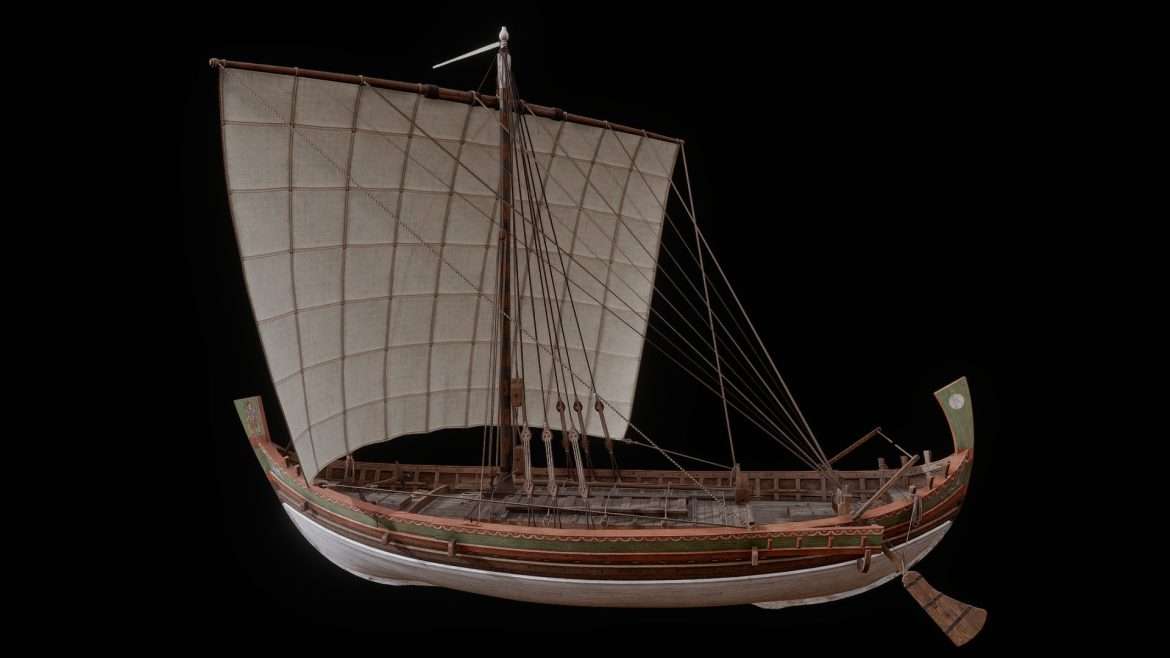
Sediment layers at the bottom of the Laurons harbor preserved the port-side hull of this 15-meter vessel with startling clarity, freezing a moment of 3rd-century maritime life in time. This digital recreation captures the essence of a small coaster that once navigated the treacherous shallows west of Marseille. Historians value this specific wreck for its rare structural elements, including the wings that supported its side rudders.
The Anse de Laurons 2 represents a class of workhorse ships that fueled the local economies of the Roman Empire. Displacing approximately 30 tons, this vessel prioritized maneuverability over sheer cargo volume. The hull design reflects the transition in shipbuilding techniques during the late Roman period, showcasing a robust frame capable of withstanding coastal storms. This reconstruction meticulously follows the archaeological plans of R. Bockius to ensure historical accuracy in every timber and joint.
Artists and historians will appreciate how the model visualizes the functional components of ancient sailing. The port-side preservation allowed archaeologists to document the railing and deck layout with high precision. By focusing on these archaeological findings, this laurons roman ship 3d model provides a tangible link to the sailors who navigated the Gulf of Lion nearly two millennia ago.
Laurons Roman Ship 3d Model – Rare Archaeological Details and Rigging
Unlike many shipwrecks that lose their upper structures to decay and currents, the Laurons find yielded a treasure trove of rigging elements and spare parts. The inclusion of a spare rudder within the digital asset mirrors the actual discovery within the wreck’s hold. This detail emphasizes the preparedness of Roman mariners who understood the risks of coastal navigation.
The model also features the distinctive side wings, which served as crucial support structures for the heavy steering oars. These elements often appear in contemporary Roman mosaics but rarely survive in the physical record. By integrating these features, the reconstruction bridges the gap between artistic depictions of the era and physical maritime engineering.
Visual Fidelity and Historical Aesthetics
The aesthetic choices for this ship draw from extensive research into 3rd-century CE Roman art. While the hull form follows strict archaeological measurements, the decorative motifs reflect the vibrant visual culture of the period. Vibrant colors and patterns based on surviving frescoes bring the vessel to life, moving beyond the bleached wood often associated with ancient ruins.
- Accurate hull geometry follows the 15-meter original dimensions.
- Detailed steering oar assembly includes functional support wings.
- Authentic rigging configurations utilize archaeological fragments for accuracy.
- High-resolution textures represent seasoned wood and period-appropriate pigments.
Integrating the Wreck into Modern Visuals
This digital asset serves as a centerpiece for educational environments, museum displays, or historical visualizations. It offers a unique perspective on the smaller, often overlooked vessels that formed the backbone of Roman trade. Users can explore the relationship between the deck space and the cargo hold, gaining insights into the daily operations of a small merchant crew.
For creators interested in other high-detail models, consider checking out our Panzerkampfwagen VI – Ausf.B – Tiger II. This Roman merchant ship pairs excellently with other Mediterranean assets to build a comprehensive historical scene. Researchers published the initial archaeological reports that detailed the initial discovery in French.
Seller Original Description
Anse de Laurons 2 is the wreck of a small Roman period sailing vessel dating to the end of the 3rd century CE, which probably sank during a storm while sheltering in the shallow harbor at Laurons, just west of Marseille in modern France. At only about 15m in length and with an estimated displacement of around 30 tons, it probably only traded between small harbors along the local coastline. When it sank, the port-side was quickly covered in sediment ensuring excellent preservation up to the deck and even the railing. Rigging elements, a spare rudder, and possible fragments from wooden panels that may have covered the hold, along with rarely-preserved structures for supporting the side rudders (the side “wings” you see in a lot of Roman period art). This reconstruction is based on plans by R. Bockius. The decorative elements are hypothetical, based on contemporary paintings and mosaics.The initial excavation report is availble free here (in French): https://www.persee.fr/doc/nauti_0154-1854_1984_num_4_1_953
Extended Use License
has been added to your cart!
have been added to your cart!
You must log in and be a buyer of this download to submit a review.
| ABOUT THE SELLER |
|
| SELLER-USER-NAME | Opus Poly |
| 3D Model formats | FBX, OBJ, BLENDER, TEXTURES, Materials |
| 3D Model details | VR / AR / Low-poly, Textures, Materials, UV Mapping, Scale transformations |
| Triangles | 186.8k |
| Vertices | 99.2k |
| Category | Cultural Heritage & History, Science & Technology |
| Tags | 3D archaeological reconstruction, ancient sailing vessel, Anse de Laurons 2, laurons roman ship 3d model, laurons-2, maritime-archaeology, Mediterranean history, merchant, nave, noai, roman, Roman merchant ship, Roman shipwreck, romana, sail, ship, vela, wooden |